


August Meeting Recap: Sedges You Know & Sedges You Don’t
written by Irene Hogstrom

Native landscaping encourages us to expand our use of different genera of plants. Scanning a native plant catalogue, or attending a native plant sale, plants are typically listed in these categories: Trees and Shrubs, Forbs, and then Grasses and Sedges. The sedge plant family of Cyperaceae contains 5,000 species around the world. There are 2,000 different species of the genus Carex in the world–one of the largest of flowering genera–with about 150 different Carex species in the Chicago region.
What exactly is a sedge?

Sedges appear to be grass-like, and Andrew pointed out these characteristics that are distinctive to sedges:
Leaves are three-ranked along a stem
Sheaths that hold the leaves to the stem are closed
Flowers are small and not showy
The Carex genus sets itself apart from other sedge genera by the female flowers being enclosed in a sac-like structure called the perigynium.
Sedges can be very demure and have a height of 6 inches, or some species can reach heights of 3 feet. They are a very important part of the understory and provide important habitat and food for invertebrates, waterfowl and other wildlife.
Where do sedges grow?
Sedges can be found in a variety of habitats and moisture conditions within the Chicago region, including prairies, forests and woodlands, marsh edges, sedge meadows and other open wetlands, including these specific habitats:
Mesic (moist) to wet prairies
Calcareous (limestone) wet prairies, grading to fens (peat)
Dry prairies (calcareous)
Dry prairies and sand barrens
Often, the presence of specific sedges can help determine the type of habitat one is exploring.
Can I plant them in my yard?
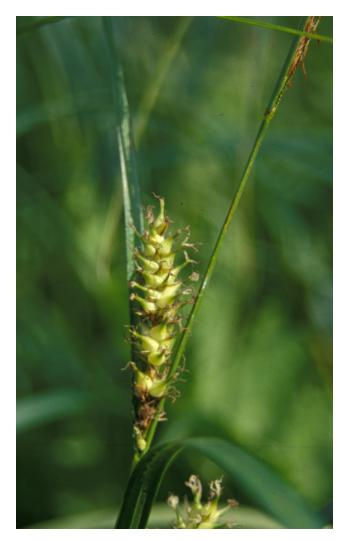
Of course! Sedges make a wonderful addition to any garden. The most common species that are easy to grow include Carex rosea and Carex radiata. Andrew recommends Carex trichocarpa as a very suitable sedge for rain gardens. Carex pensylvanica looks very grasslike and is sometimes used as a lawn replacement, however it does not tolerate heavy use like Kentucky bluegrass.
Learn More
There are plenty of opportunities to learn more about sedges.
Take advantage of local field visits and classes offered by the Morton Arboretum and other conservation organizations.
Visit the Herbarium at the Morton Arboretum. Andrew will lead a tour (limit of 20 people) for Greener Grove on Wednesday evening, November 4. Look for upcoming details from Greener Grove.
Check out these suggested regional Field Guides:
Field Manual of Michigan Flora, by Edward G. Voss and Anton A. Reznicek
Field Guide to Wisconsin Sedges: An Introduction to the Genus Carex, by Andrew Hipp
Flora of the Chicago Region, by Gerould Wilhelm and Laura Rericha
Sedges of Indiana and the Adjacent States, by Paul E. Rothrock
Visit the Global Cyperaceae Database online:
Take Action
What You Can Do:
Increase habitat for wildlife by incorporating sedges in your home landscape.
Review the handout provided by Andrew for species that grow in various habitats that might be similar to your home environment (full sun, shade, dry or wet soils).
Purchase sedges at local native plant sales or from local native plant nurseries.
And remember, take only photos of sedges while visiting our local nature preserves.


Comments